Draw the skeleton back on
Ten frames, joints connected by limb. A swapped left and right is instantly visible as crossed legs and invisible in any metric.
A keypoint dataset is a list of joint positions per person, each carrying whether the camera could actually see it. The positions are the easy part. The visibility flag is where hand annotation becomes guesswork and where a rendered scene has an answer, and the flip map is where a whole training run quietly comes to nothing.
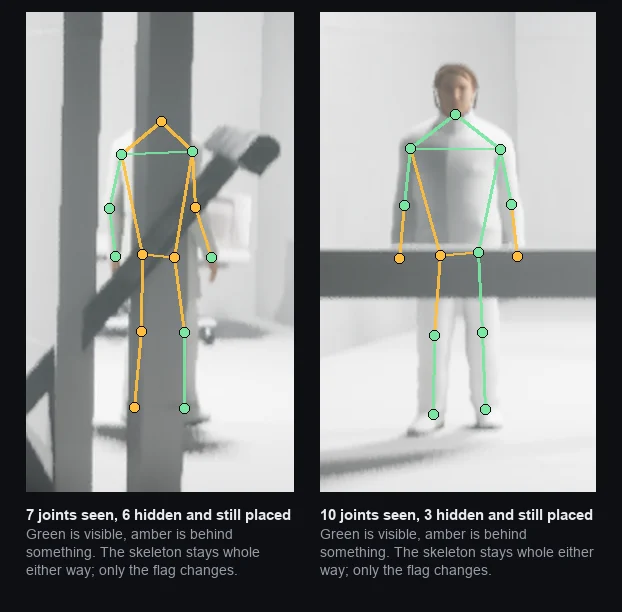
COCO gives every joint a visibility value, and the three values are not degrees of confidence. They are different claims.
| State | Value | What it claims |
|---|---|---|
| Not labelled | v = 0 | the joint is not in the annotation at all |
| Labelled but not visible | v = 1 | the position is known, something is in front of it |
| Labelled and visible | v = 2 | the camera can see it |
The middle one is the whole problem. Asking a human to mark where an elbow is when a table is in front of it is asking them to guess, and different annotators guess differently. Most real datasets are inconsistent here, and a model trained on them learns that hidden joints are unpredictable, which they are, in the labels.
A rendered scene does not have to guess. The skeleton has a position whether or not anything is in front of it, and whether something is in front of it is a question the renderer answered in order to draw the frame at all. The middle state stops being expensive.
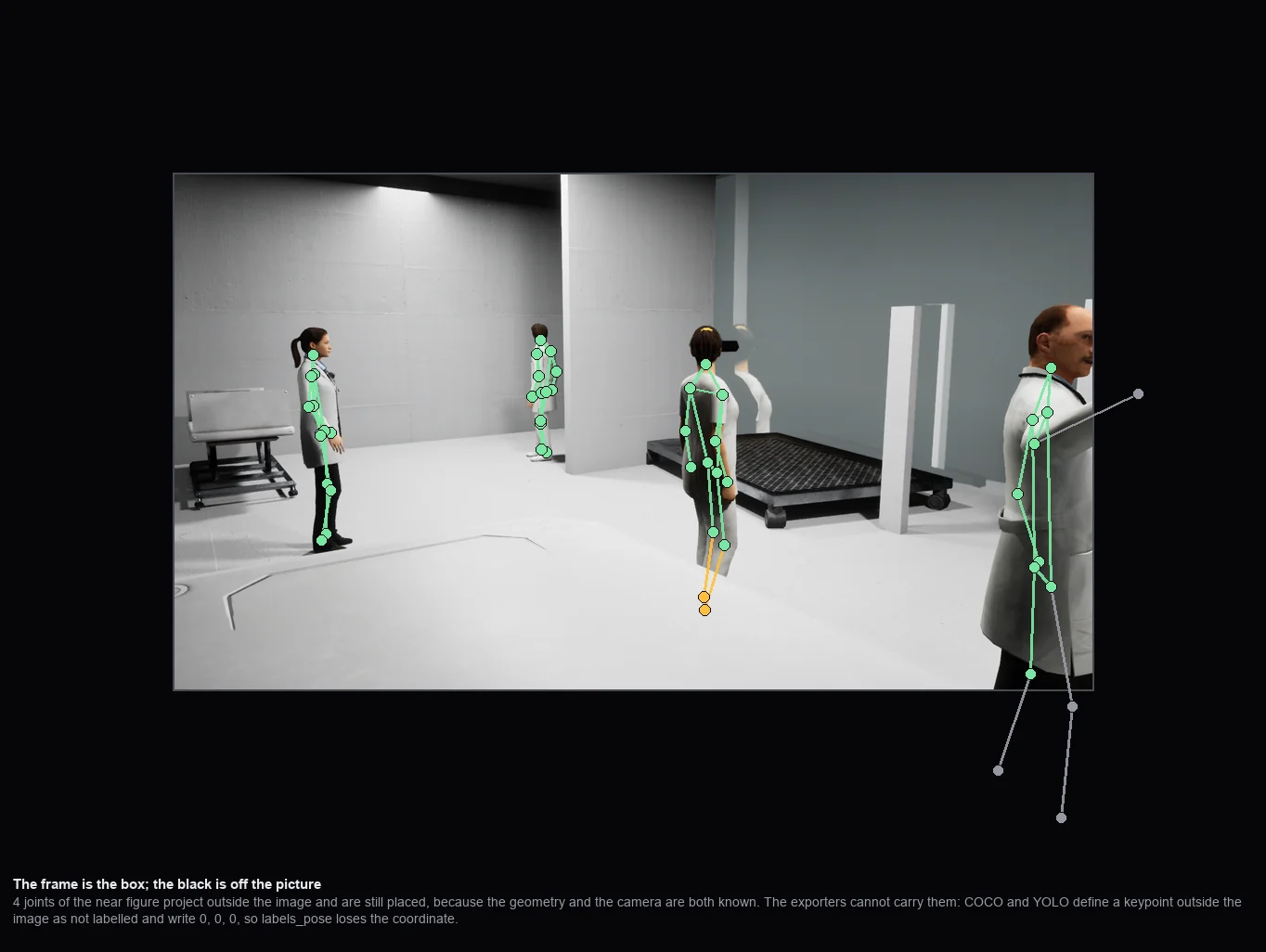
A person walking out of frame has a shoulder in the image and a wrist beyond its edge. The wrist has a real position; the picture simply does not reach it.
Both formats define this away. A keypoint outside the image is written as not labelled, with its coordinates zeroed, and the information is gone. That is a limit of the formats rather than of the capture, and it is worth knowing before you design an experiment around partially visible people: the answer exists, and the file you export cannot carry it.
What you can do is decide deliberately rather than by default. Zeroing is the correct, conservative choice and what most training code expects. Clamping the joint to the frame edge is a lie that looks like data. Keeping the true out-of-frame coordinate is useful for analysis and will confuse a standard loader. Pick one, and write down which.
This is the one to read even if you skip the rest.
Nearly every training pipeline mirrors images as augmentation. Mirroring a photograph of a person turns their left side into their right, so the labels have to swap too: the left wrist in the original is the right wrist in the mirrored copy. Doing that requires a table saying which keypoint index becomes which.
Without that table, nothing fails. No exception, no warning, no malformed file. The left wrist simply keeps its index on the mirrored copy, so the model is shown one limb labelled two different ways, in roughly equal numbers, for the whole run. It learns that limb is unpredictable. Loss falls, the model trains, and the wrists never converge.
The table is mechanical once the joint order is fixed: every left index maps to its right counterpart, every right to its left, and anything on the midline maps to itself. Ship it with the dataset. A pose dataset without a flip map is a dataset with a trap in it.
Seventeen-joint COCO, twenty-five-joint OpenPose and the various hand and face extensions are different vocabularies, not different levels of detail. A model trained on one cannot read the other, and a dataset that mixes them is unusable without a remapping step somebody has to write and verify.
So the decision to make first is which downstream code you intend to feed, and then to keep the joint order fixed and published alongside the data. An order that changes between two exports of the same dataset is the same failure as the missing flip map, arriving from a different direction.
Ten frames, joints connected by limb. A swapped left and right is instantly visible as crossed legs and invisible in any metric.
Flip a frame and its labels with your flip map and draw both. If the wrists end up on the same side of the body in both, the map is wrong.
A dataset where almost nothing is state one is a dataset that is guessing about occlusion or has none. Both are worth knowing before training on it.
Keypoints are asked for per class in the capture job, and they come out of the same run as the picture, the masks and the boxes, from the same instant. Each joint carries its visibility, taken from what the renderer drew rather than estimated, and the flip map is written into the dataset beside the joint order.
nameframe label   D:/runs/street  D:/runs/street/labels
nameframe dataset D:/runs/street  D:/runs/street/dataset \
    --task pose --format yolo,coco
What happens to a joint that is occluded, and what happens to one outside the frame, are both measured rather than asserted on the occlusion page, which publishes the results including the ones that are limits.