

Colour collisions
Two objects assigned the same identity colour merge into one instance. Checked on every run with zero tolerance for near-matches. Reference capture: 289 colours across 289 classes, no collisions.
“Ground truth” in a real dataset means a human’s best guess, agreed between two annotators and a review pass. In a rendered scene it means something stricter: the values the renderer used to draw the frame. This page is about where those values come from and how you check that they are right.
Everything NameFrame writes comes from three places, and it is worth being precise about which is which, because they fail differently.
Pixels and transforms are two independent descriptions of the same scene, which means they can be checked against each other. Project each recorded actor position through the camera and it should land inside the blob that the identity buffer says belongs to that actor. If it does not, something is wrong: the wrong colour, a stale transform, an object that moved between the render and the record.
That check runs on every capture. On the reference run its result was: 197 blobs match their recorded actor positions. A pipeline that only produced masks would have no way to run it.
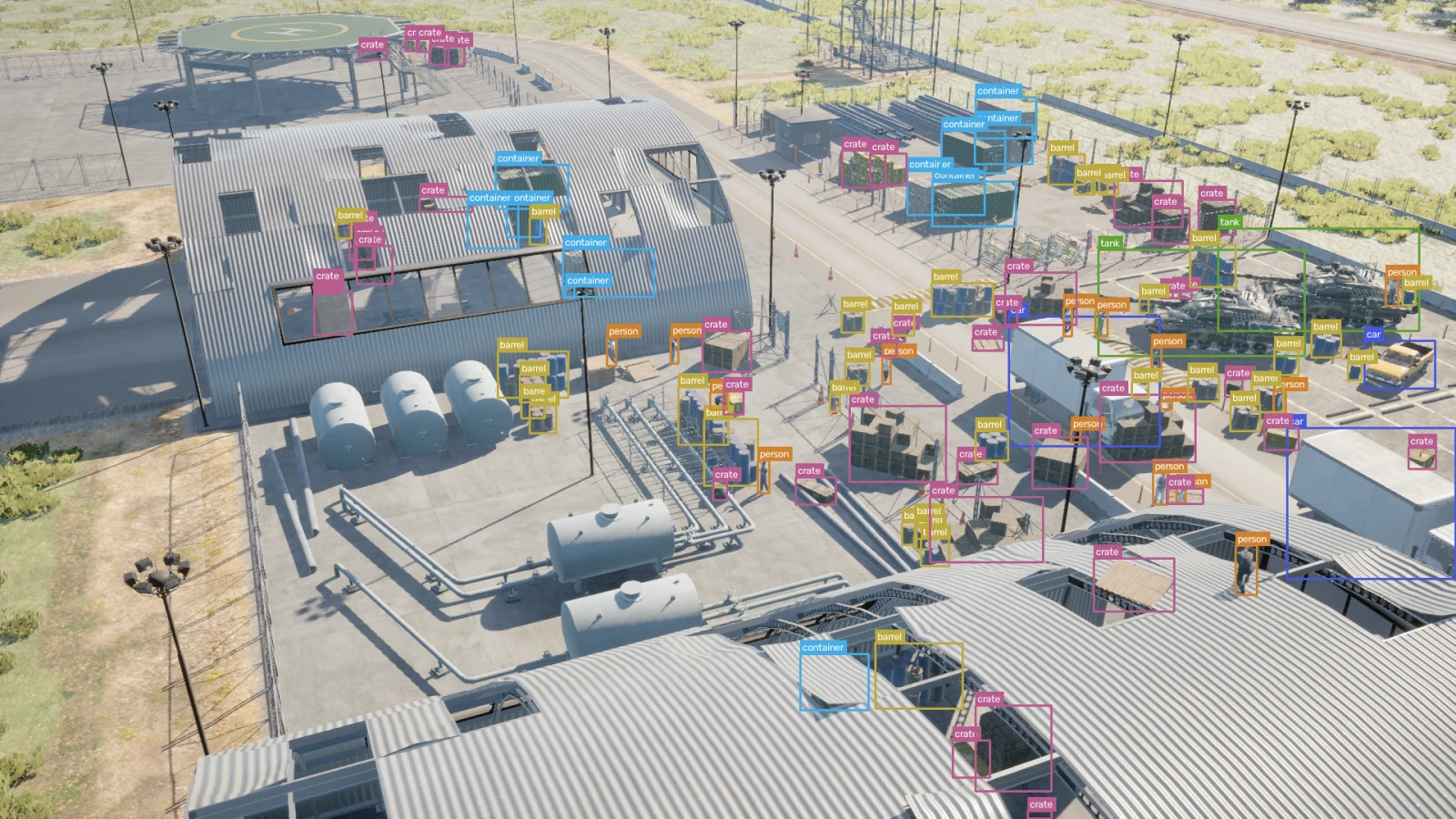
Engine-derived does not mean infallible. These are the real failure modes, and what the pipeline does about each.
Two objects assigned the same identity colour merge into one instance. Checked on every run with zero tolerance for near-matches. Reference capture: 289 colours across 289 classes, no collisions.
A thin object in front of another can take pixels that belong to its neighbour, leaving the neighbour with no box at all. This is the check the reference capture failed, and it is reported rather than hidden.
An object seen through a railing arrives as several disconnected blobs. Those are reassembled into one instance rather than counted as several: 1,409 fragments merged across the reference run.
Some actors deliberately carry no identity, so they render into the picture but never into a label. 14 in the reference capture. Distinguishing these from a bug matters.
Most of the trouble in a synthetic pipeline is a sign convention nobody wrote down.
All of it is in the frame records inside the downloadable sample packs, so you can check the conventions against real files rather than against this paragraph.