2,263 instances
Under 32×32 pixels of area. More than half of everything in the capture. These are the objects a detector will miss first, so they are the ones worth having in quantity.
A bounding box is the cheapest useful label in computer vision and the most tedious to produce by hand. Generated from an Unreal scene it costs nothing per instance, which changes what you can afford: the reference capture on this site carries 4,378 boxes across 40 frames, and no one drew any of them.
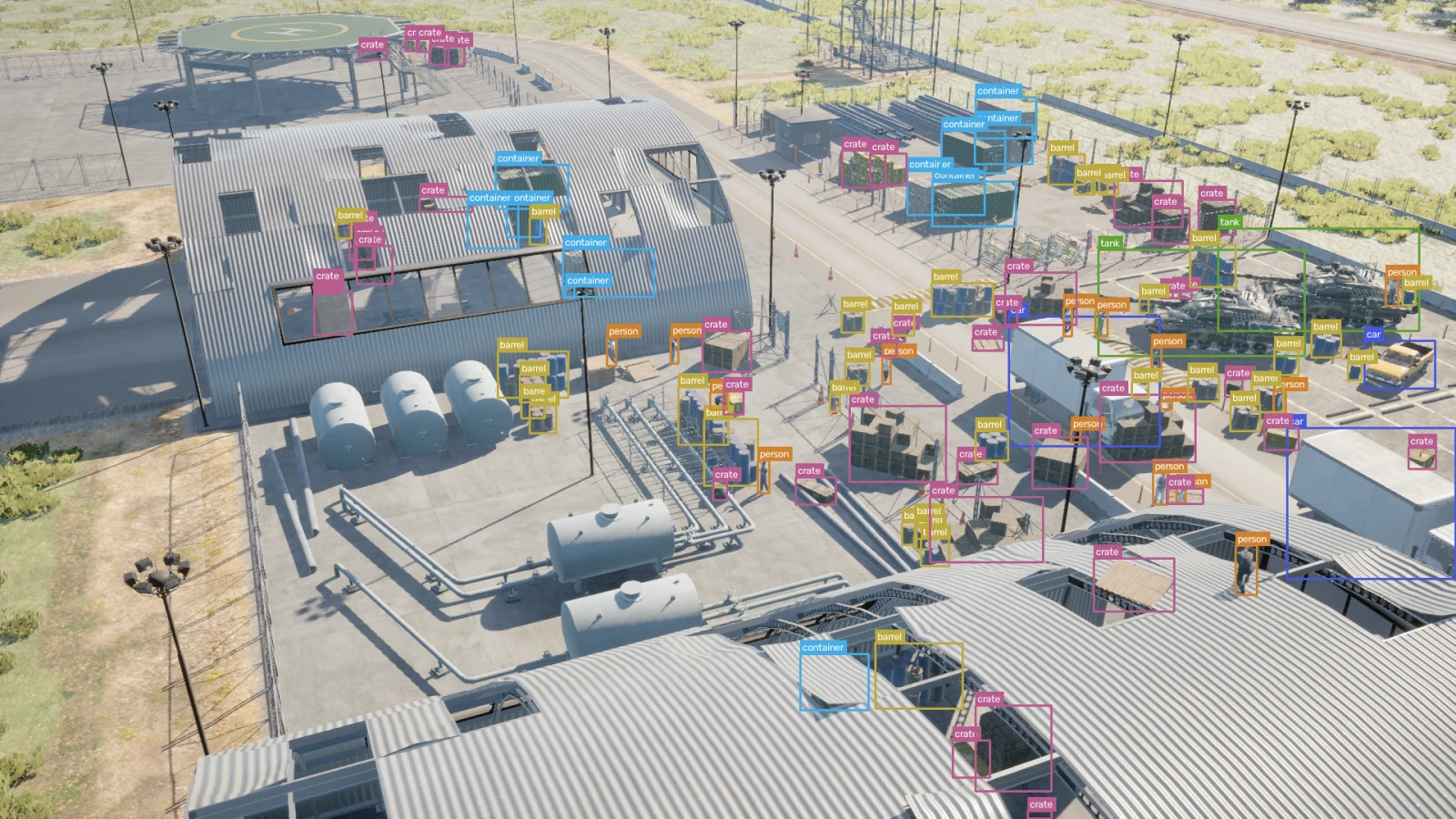
Not from the object’s 3D bounds projected into the image, which is the approach that produces boxes floating around objects that are mostly behind a wall. The box comes from the identity buffer: find every pixel painted with this instance’s colour, take the extremes. If two-thirds of a crate is hidden, two-thirds of its pixels are not there, and the box tightens accordingly.
That is what “occlusion-aware” actually means, and it is a property of where the data comes from rather than a feature someone implemented. An object with no visible pixels gets no box, because a box around something you cannot see is a label that teaches a detector to hallucinate.
An object crossing the edge of the frame is a real case that a detector has to handle, so it is kept and flagged rather than dropped. 168 instances in the reference capture touch an edge. Which ones, and per class, is in the report that ships with the downloadable sample.
Aerial scenes are mostly small objects. That is not a defect to be smoothed away, it is the problem, and a dataset that hides it will train a detector that cannot do the job.
Under 32×32 pixels of area. More than half of everything in the capture. These are the objects a detector will miss first, so they are the ones worth having in quantity.
Between 32×32 and 96×96. The comfortable middle of most detectors.
Over 96×96. Vehicles and containers close to the camera. The rarest category here, which is what an aerial viewpoint does.
Measured by object width rather than COCO bracket, the median instance in this capture is 23.26 pixels across and the largest is 205.94. The quality page plots the full distribution alongside distance, view angle and class balance.
Real scenes are unbalanced. Publishing the balance is more useful than pretending to have fixed it.
| Class | Boxes | Frames | Truncated | Fragments merged |
|---|---|---|---|---|
| barrel | 1,471 | 40 | 40 | 332 |
| crate | 1,216 | 40 | 45 | 494 |
| person | 996 | 40 | 17 | 164 |
| container | 361 | 39 | 38 | 220 |
| car | 254 | 40 | 28 | 119 |
| tank | 80 | 40 | 0 | 80 |