

median 23.26 px across
2,263 of the instances are small by COCO’s definition, 1,802 medium, 313 large. An aerial capture is a small-object problem, and training at 640 pixels throws most of it away.
Object detection is the task synthetic data is most obviously good at, because the annotation it needs is the one that scales worst by hand. A dense frame is an hour of somebody’s afternoon; the reference capture on this site carries 4,378 boxes and cost nothing per box.
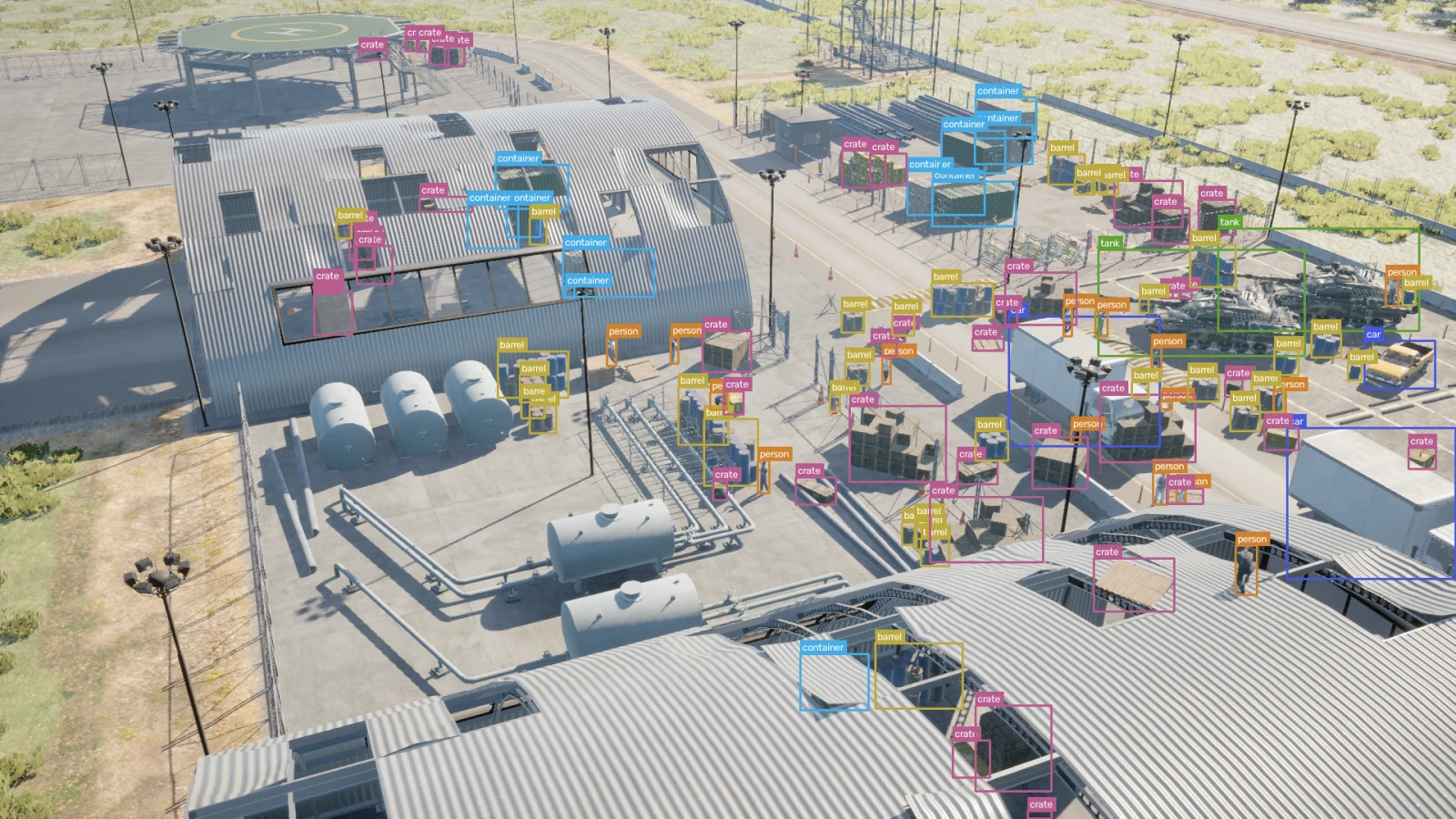
Two formats from one capture, and they carry the same information in the two conventions the ecosystem actually uses.
# YOLO: labels/train/<frame>.txt — class id, centre x, centre y, w, h (normalised)
5 0.63125000 0.82546296 0.06041667 0.08055556

# COCO: annotations/instances.json — bbox is [x, y, width, height] in pixels
{ "image_id": 4, "category_id": 2, "bbox": [1697, 564, 223, 200],
"area": 26339, "iscrowd": 0 }A detection dataset is defined more by its size and distance distribution than by its frame count, and both are measurable in advance.
2,263 of the instances are small by COCO’s definition, 1,802 medium, 313 large. An aerial capture is a small-object problem, and training at 640 pixels throws most of it away.
Instances sit between 33.19 and 187.81 metres from the camera, concentrated between 40 and 120. If your deployment is at fifteen metres, this capture is not the one you want.
Class counts follow the scene, not a target. Decide whether to weight the loss or spawn differently before the first epoch, not after.
# train straight from the pack
yolo detect train data=data.yaml model=yolo11s.pt epochs=100 imgsz=1024

# imgsz matters more than usual here: at 640 the median 23.26px object
# is roughly 8px, which is below most detectors' useful floorThree things that will bite, in the order they usually do.
Detection is relatively forgiving of appearance differences compared to fine-grained classification, but “relatively” is not “immune”. Evaluate against real data.
A model trained on this capture learns airbase tarmac in daylight. Variety needs more scenes and more conditions, which is cheap to run and real work to author.
Real detection sets have annotator noise, and models trained on them learn to tolerate it. A perfectly labelled synthetic set is a different distribution in a way that occasionally matters.